Blog · Show planning
How to plan a magic show with a cue sheet
Aug 18, 2026 · Updated Aug 31, 2026 · 8 min read · Housecue
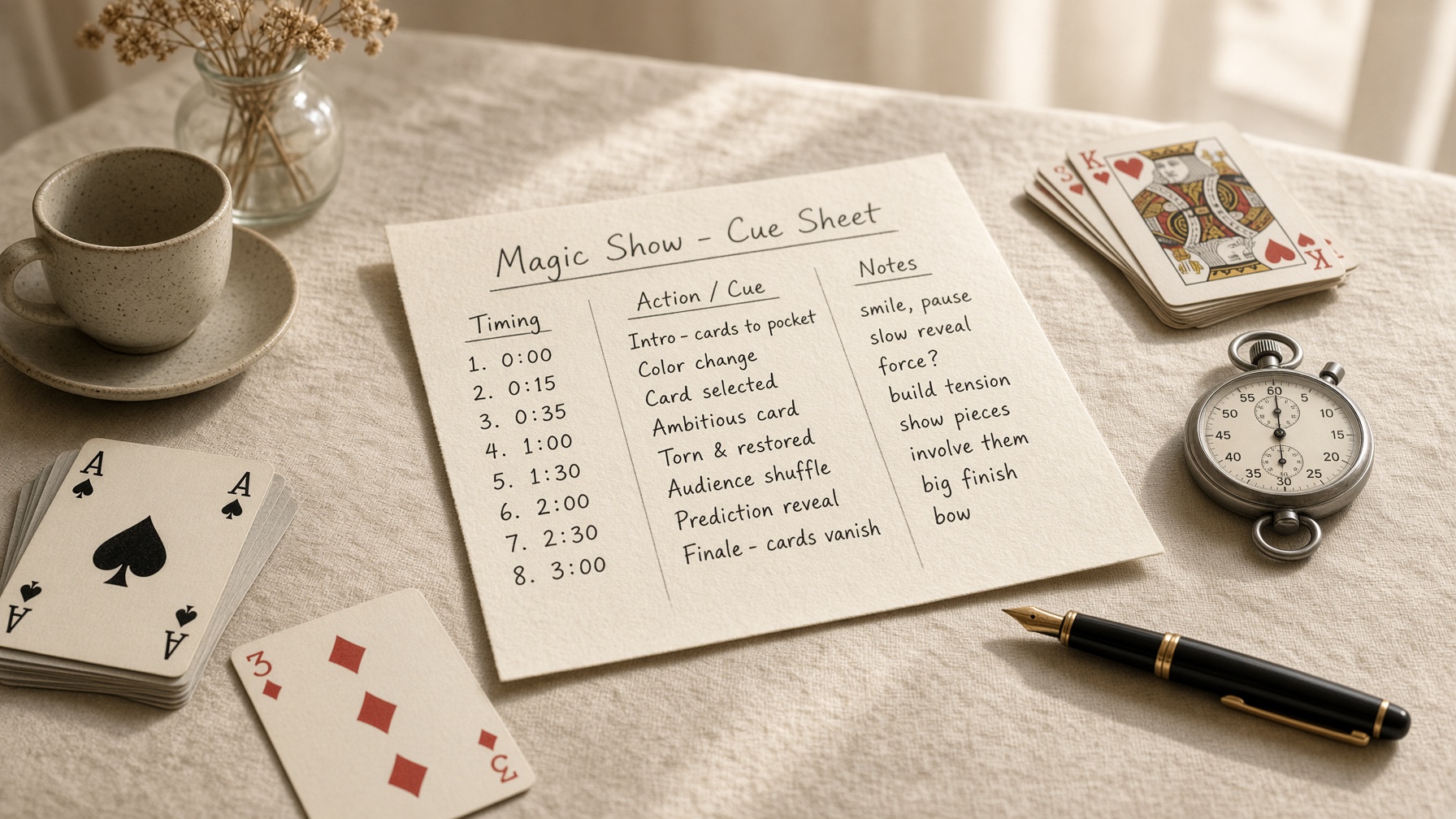
A complete guide to writing a magic show cue sheet: sequence, timing, props, music, and director notes. Built for magicians and any live entertainer who works a timed set.
Most magic shows do not fail because the method is weak. They fail because the night has no spine. A borrowed deck, three silks, and a ring routine is not a show until someone decides the order, the minutes, and what is in the hands at each cue. That document is a cue sheet — sometimes called a rundown, a running order, or a set list with teeth.
This guide is written for working magicians, and it holds for mentalists, variety, circus, and musicians who time a live set. It is the same craft: sequence, duration, object, note. Housecue stores that craft in a private show plan, then turns it into a packing list and a run of show when the date is real.
If you still keep the act in a notes app, a rehearsal video, and a text to yourself, you already know the cost. The opener resets in the wrong pocket. The closer needs a table that is not there. The silk is “somewhere in the trunk.” A cue sheet is how you stop improvising the business of the act.
What a cue sheet is — and what it is not
A cue sheet is a private rundown for the performer, the technician, and anyone who packs the case. Each line is one piece of the act: a title the house understands, a duration in minutes, the prop it needs, and a director note you will not remember at 19:40 while the host is still seating tables.
It is not a script for the audience. It is not a public playbill. It is not a list of every trick you own. Those three mistakes are how cue sheets die: too literary, too public, or too complete. Write only what will happen on this night, in this room, in this order.
- Title — the name you use in the house, not the marketed name of the trick.
- Duration — minutes you will actually spend, including applause and reset.
- Prop — the object from inventory, not a vibe (“cards”).
- Note — reset, stooge, music, light, or a line you must not forget.
Write the act as a sequence, not a pile
Open a show plan and add cues in the order they will happen. Not the order you learned them. Not the order that looks impressive on paper. The order a room can follow after dinner, with waiters, with a child at table four, with a playlist that will not pause unless you asked.
Openers, middle, closer
Openers reset in the pocket and do not need a table. They buy you the room. The middle can ask more: a guest, a surface, a quiet. The closer should leave the room still — a final load, a silk cascade, a song that does not need a lyric. If your closer requires a follow-spot you will not have, it is not a closer. It is a wish.
Time every piece
Ambitious card at eight minutes. Rings at ten. Silk at six. Final load at four. Those numbers are not decoration. They are how you know a “45-minute parlor” is 45 minutes and not 28 plus panic. Include the walk to the table. Include the reset. Include the laugh you always get, and the one you do not.
When a host books 20 minutes, do not shrink the 45 by talking faster. Keep a second show in the studio — close-up twenty — with its own cues. Attach the right show to the hold or confirmed date. Do not retype the act in a parking lot.
Attach the prop you will actually carry
A cue named “cards” with no deck in inventory is how a crate leaves home light. Each cue should point at a record in prop inventory: the Bicycle rider-backs in tour case A, the rings in case B, the ivory silks in the costume trunk. Quantity and condition travel with the name.
Housecue builds the packing list from those attachments. Unattached cues show as gaps — a finale with no silk is visible before you are on the pavement. That is the point of one desk instead of two spreadsheets that drift apart by Thursday.
If a piece uses a borrowed ring, say so in the note, and still attach the cloth wrap you need when nobody offers a ring. Hope is not a prop.
Director notes stay off the playbill
The notes field is for the house, not the host. “Signed card, reset in the jacket.” “Invite one guest. Keep patter spare.” “Music cue: low strings, no lyric.” “Warm light, never a follow-spot.” Those lines are how you protect the method, the mood, and the next night.
They should never sit on a public performer page, in a shared Google doc with the venue, or in an email thread with a planner who forwards everything. Keep them in a private studio. When the date is booked, the same notes appear on the run of show you print for yourself — not on the invoice the host opens.
Music, light, and the room
A cue sheet that ignores the room is a rehearsal, not a plan. Write the music against the piece that needs it. Write the light you will accept: warm, practicals only, no follow-spot. Write whether you can work standing, seated, or table-to-table. A parlor set that assumes a stage will die in a restaurant.
If you travel with sound, put the speaker in inventory and attach it to the first cue that needs it. If you do not, write “house playlist paused” so you remember to ask. The run of show will carry load-in and call; the cue sheet carries what happens after you are on.
From cue sheet to the night
A show in Housecue is reusable. Name it — Close-Up After Dark, Family Matinee, Parlor Forty-Five — mark it ready, and attach it to the next booking. The cues travel. The packing list prints. The invoice still has its own job: deposit, balance, or full fee.
- Write the show as cues with minutes, props, and notes.
- Keep inventory honest so the crate can be built from the act.
- Hold or confirm the date on the calendar.
- Open the run of show the day of: clock times, who to find, crate.
- Invoice from the booking, not from a separate memory of the fee.
Rehearsal on Housecue is free for three shows. That is enough to write a real act and take it to a first host. Studio Pro is for the season. Start a studio and put the next cue on paper before you pack the case.
A worked example: parlor forty-five
Here is a parlor set as it might sit in the studio — not a prescription, a shape. Adjust minutes to your voice. If your ambitious card is twelve minutes because you let a child sign, write twelve.
- Walk-on and a borrowed name — 3 min — no prop — note: warm light, no mic unless the room is a hall.
- Ambitious card — 8 min — rider-back deck — signed card, reset in the jacket, two backups in the same case.
- Linking rings — 10 min — 8-inch rings — one guest, spare patter, cloth wrap in the case.
- Silk cascade — 6 min — ivory streamers — music: low strings, no lyric.
- Table-side final load — 4 min — second deck — leave the room still, no encore unless asked.
- Reset and thank the host — 2 min — no prop — do not pack in the room if you can help it.
That is 33 minutes of material plus air. If the contract is 45, you still have room for a piece you trust, or for the waiters. If the contract is 20, this is the wrong show — open Close-Up Twenty instead of cutting this one in the car. The run of show will clock these lines from the booking’s start time so 20:00 is 20:00, not “about eight.”
Rehearsal notes versus performance notes
While you are still writing the act, the cue sheet is a rehearsal document: timings will lie, notes will be messy, a piece will die. That is what “draft” is for. When the show is ready, clean the titles, freeze the minutes, attach the real props, and stop editing on the day. Performance notes are short. Rehearsal notes are a diary. Do not carry the diary into the room.
If a joke fails three nights running, cut it in the studio after, not mid-set with a pencil on the call sheet. The run of show should look like a grown-up wrote it. The draft can look like a magician wrote it, because a magician did.
Questions
- What is a cue sheet in magic?
A cue sheet is a timed running order of the act: each piece, how many minutes it takes, which prop it uses, and a private director note. It is for the performer and the crate, not for the audience.
- How long should a magic show cue sheet be?
As long as the booked set, plus resets. A 45-minute parlor might be six to ten cues. A 20-minute close-up might be four. If the minutes do not add up to the contract, rewrite the sheet — do not talk faster.
- Should I share my cue sheet with the venue?
Share timing, load-in, and technical needs. Do not share method notes, stooges, or resets. Housecue keeps the full sheet private and lets you print a run of show for yourself.
- Can musicians or circus acts use the same cue sheet?
Yes. A set list with minutes and a prop or instrument on each line is the same object. See our note on one gig book for every entertainer.
Keep the house in one desk.
Cue sheets, inventory, holds, invoices, and a run of show — private after you sign in.